
Miri Kim
Severe Atopic Dermatitis, Topical Steroid Withdrawal, Low Back Disc Herniations

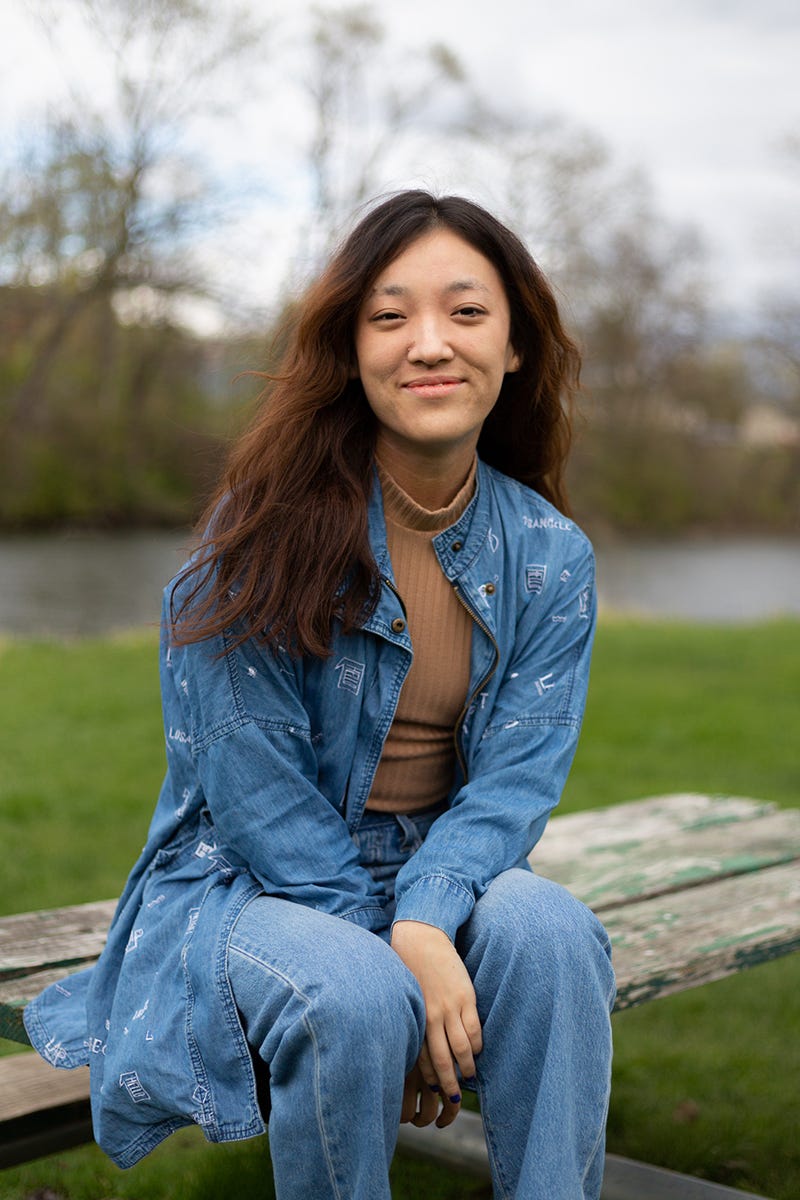
Miri is an activist and community organizer. In this interview, she discusses how a severe, lifelong battle with eczema and the complex process of Topical Steroid Withdrawal (TSW) have challenged her physical mobility and sense of self-worth. She opens up about confronting internalized ableism, the reality of living with chronic pain, and how she finds inspiration in the joy of others.
Would you mind telling me about your disability?
Miri: I have been chronically ill since I was an infant with a severe form of atopic dermatitis, or eczema. A lot of people have mild versions of it and tend to grow out of it. I had a lot of allergies and food intolerances throughout my life, and I still do, related to it. In the last few years, I’ve been going through something called Topical Steroid Withdrawal, which is not something that is really recognized by the mainstream medical establishment. It’s a result of using topical steroids, which is the first thing that they prescribe for a lot of things related to your skin, not just atopic dermatitis. So that is manifesting as a way more severe form of what I’ve been going through for my whole life.
My mom is a nurse and she was always very, very against me using topical steroids. When I turned 18, I was able to make my own medical decisions. The doctor had always been like, you should try it, you should try it. I was like, okay, fine; let’s try it. Then, I really started to take inventory of how dependent my body was on it. I was like okay, I should probably start to cut the steroid out, because anytime I didn’t use it, I would really, really suffer. I wanted to wean myself off of it. When everything shut down in 2020, it was kind of a blessing. It was like the perfect opportunity to wean myself off. So I’ve just been kind of recovering very slowly.
It’s a long journey, and I think there’s still a long stretch ahead of me. I try not to put any expectations or timelines on my physical health.
Laura: How does steroid withdrawal make you feel? How can you feel it manifesting in your body?
Miri: There’s a few layers. When I was first going through it, and when it was at its most severe, my thermal regulation was off. My ability to regulate my body’s temperature is still pretty shot, but it was even worse then. My skin from head to toe was flaking off and peeling, and crusting over. So, that also meant I was losing a lot of hair, because the skin wasn’t able to be healthy enough to produce hair growth. So, with all those changes, it really affected me emotionally and mentally and still does.
I’m still working through the agoraphobia that was really, really present in 2021, and the social anxiety. It’s really made me have to grapple with my internalized ableism and face it head on. I found myself not feeling good about myself when I was looking a certain way, which I can’t control. When I was not able to do certain things, especially care tasks, as a woman, a lot of those would affect my sense of self worth and also identity. I realized those were so intertwined with what I conceptualized as what made me a valuable person.
I was kind of grappling with the identity of disability from when I was in undergrad. When I started to need accommodations in school they were like, well, you need to apply and fill out this form and go through this process under the students with Services for Students with Disabilities. So basically, the labor was pushed on to me before I was really ready, which kind of made me grapple with like, am I disabled? Am I not? So, in a way it made me start to have those questions and wonder what my relationship with disability is, but it did so in a very not ideal way.
Laura: I feel like a lot of us are confronted with the disability identity in a way we wouldn’t prefer, but once you accept it, life gets easier.
Miri: I also have lower back disc problems that herniate now and then. That happened first in high school. There was a period like junior year, when I was like, not able to get up or walk for a week and a half to two weeks. I had to go through really strenuous physical therapy and see a chiropractor and all of that stuff. It’s wild to think back to that time, because even then, I was really unable to conceptualize myself as a disabled person. Even when I was having really limited mobility and chronic pain, which is kind of how a lot of people conceptualize disability, I wasn’t able to see the ways in which disability resonated with my life.
It is better managed now, because I have a better idea of what sorts of things to avoid, like carrying heavy things. I haven’t actually had a flare up with my back thankfully, since like, maybe mid college? So it’s been at least a few years now. In terms of mobility with my skin, when it got really, really painful, at its most severe in 2021, it was hard to join some stuff. That affected my mobility as well, but in a completely different way.
Laura: What do you do for skin pain? Is there anything you can do?
Miri: Cold and heat mostly. There’s honestly not a ton you can do, so it’s hard to find management strategies. I was scouring online and finding groups of folks that were dealing with Topical Steroid Withdrawal, as well. It’s just like a bunch of people that are just exchanging tips and tricks, all imperfect.
What do you do for fun?
Miri: I’m really getting back into reading. It kind of took a back burner while I was in school. I really enjoy bullet journaling. I work mostly remotely, so I find that something really analog, like drawing out a spread or putting stickers on a page is really grounding. I really enjoy singing and dancing, although dancing has not been something I’ve been able to do as much the past few years. It is something that I did enjoy a lot in undergrad and will probably try to incorporate back into my life slowly.
Laura: Have you read anything good lately?
Miri: The book I’m reading right now is called How to Keep House While Drowning.
I first found her on Tik Tok. Her name is Casey Davis, she’s a licensed therapist, and someone that is really open about how difficult it is to do really basic things when you’re disabled, neurodivergent, etc. In the intro of the book she says, maybe you don’t have the time or the energy capacity to read this whole book, so there’s an abridged way to read the book. It’s been really validating to read that it’s okay if things like cooking and keeping house and stuff like that are hard.
What motivates or inspires you?
Miri: Motivation has been an interesting theme in my life the past few years. What inspires me, I think, is other people’s joy. That’s kind of related to how I realized I like being, as someone that works remotely, in spaces that are energizing to work as opposed to really quiet. I think it’s because I derive a lot of energy from other people’s energy. So, I feel inspired by seeing other people experience joy. Especially other disabled people and other people of color. I am really motivated by wanting to live a joyful life, which has been a theme for the past few years, especially after graduating school. When I was a student, I was really internalizing the rhetoric that joyful things take a back burner, because your priority should be school. In post-grad life that has kind of transferred to your priority should be work and that should be the main thing you’re doing and what you’re allocating your energy to. I realized that doesn’t make for a fulfilling or sustainable life. So, I’m inspired by trying to figure out what it is that I can do to live a joyful life. Also, I am a community organizer, and so I want to figure out how to balance organizing, and political work.
What change would you like to see for disabled people in the future?
Miri: I think I would want disabled people to feel worthy, and like a whole person at every point in their life, and for that to really manifest day to day. Something I kind of touched on that I was struggling with was my conception of self worth, when I was not able to do things or show up in certain ways, and that’s still something I grapple with. I know I am definitely not alone in those feelings and that is something internalized by disabled people day to day, which is really hard, right? A lot of that is really tied to us living under capitalism and white supremacy. I want folks to feel empowered to feel like they are worthy, because everyone is. On a grander scale, folks not having to do certain things to be worthy of necessities for survival I think is the long term goal.
as an asian american (with a nurse mom!) with eczema i have literally never felt more seen. absolutely love this!!