
Patricia Lay-Dorsey
Artist, Activist, Multiple Sclerosis

Patricia Lay-Dorsey is, at her core, an artist. Living with primary progressive multiple sclerosis, she has spent decades creating art and documenting her life through photographs. As a fellow disabled photographer, I found our conversation affirming. Her commitment to adapting to life’s changes while protecting her independence left an impression on me. I hope you enjoy reading Patricia’s words as much as I enjoyed hearing them, and I encourage you to explore her work on Instagram at @patricialaydorsey and on her website, www.patricialaydorsey.com.
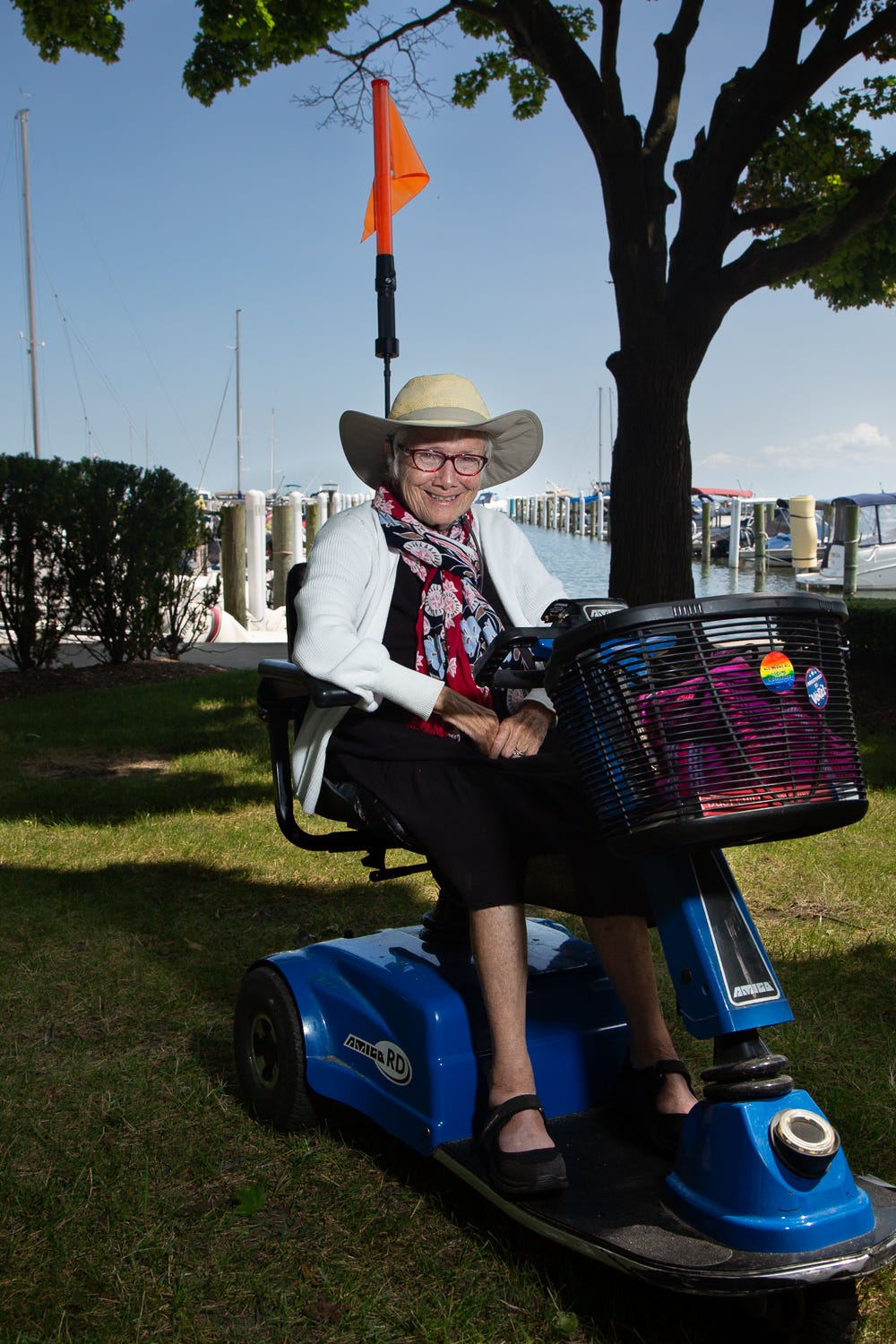
Would you mind sharing about your disability?
Patricia: On September 8, 1988, I was diagnosed with primary progressive multiple sclerosis (MS) at age 46. I had started taking unexplained falls, about five of them, and finally friends said, “You’ve got to go see somebody about this.” So, I went to my primary care, he sent me to the neurologist. The neurologist wanted to do an MRI, but our insurance did not cover the MRI, which at that time was $1,000. I said, “No, thank you. Can you just do with my story?” And so he did, and he gave me a 75% chance of it being chronic progressive MS. A year later, he had put it to 100% with the few little tests he could do.
Laura: How does MS progress?
Patricia: It’s different for everybody. I did everything I could to forestall the progression, but not medicines. I’ve never taken any medicine for my MS. I’m really not into medicine, nor do I even see a neurologist.
Well, the first thing I said was, I’m not drinking any more alcohol at all. I never did much, but it would always make me a shade off. I thought, “I don’t need to be a shade off.” So, right away I gave up alcohol. And then I became a pescetarian. I tried being a full vegetarian, but I don’t cook, and I wasn’t getting enough protein. So, I’m a pescetarian and have been that ever since. Then, I started working out with a trainer at the gym, Matt. I worked with Matt from 2004 to 2018. At that point, things had started progressing, and it seemed as though it wasn’t going to work as well for me to do that. Also, my attitude. Big time on attitude. I wasn’t going to focus on it. When I was first diagnosed, I went to one of those six-week group sessions for newly diagnosed MS people. Well, that just really turned me off, because all anybody wanted to do was talk about their MS. I did not want to do that. I’m an artist and at that point, I was in art school. So, I thought, “I’m gonna handle this my own way, and I’m not gonna focus on it.” It’s part of my life, I deal with it, but it’s not my be-all, end-all, it’s not my identity. It’s not who I am.
Laura: Do you have any friends with MS now?
Patricia: I can’t say that I have any friends with MS, or even any disabled friends, per se. Again, it’s been part of my life, but it’s never been my focus, and it’s not particularly been my identity, although in 2008,
I started taking self-portraits. It started just because I was sitting on the toilet, and I had my camera, which I always used to have with me, and I had my scooter, and I saw the sunlight in the lap of my nightgown, and it looked cool. I got my camera, I took a picture, and then I looked down at my feet on the floor, and then there was, again, some interesting sun. I took a picture. For some reason, I then said to myself, “Okay, I’m gonna get in the shower and take a picture of myself in the shower.” And I was using a shower chair, and it was a big deal to get in and all that, but I put it far enough back so that my camera didn’t get wet, because I was using my Canon, and I took a couple of pictures there. Honestly, when I did that, and I looked at those, I said, “I think this is a new project.” Because I’d always worked in projects. It would be a project of my living with my disability.
So, I worked on that starting in 2008. Then, in 2012, I went to PhotoFest in Dallas, the large portfolio review. A fellow from Wales, who ran a photo gallery, loved it. He wanted to publish the book, called Falling Into Place. So, you know, that was an amazing adventure. I was able to go on press in Antwerp, Belgium, by myself, with my scooter, scooting to the plane, changing planes, and staying overnight in London, all of it.
Laura: You did that all by yourself?
Patricia: Yup. I always traveled by myself. I even went to Lebanon by myself, with my scooter.
Laura: What are the logistics of that? Do they put your scooter under the plane?
Patricia: They do. I would roll my scooter right up to the door, and they would transfer me into one of their wheelchairs, and then put me into a seat. Then I would generally have to wait after everybody else goes, and then they would pull up my scooter, and hope that nothing happened to it.
Laura: Have you had any issues with that? I know wheelchairs get damaged on flights a lot.
Patricia: The only time I had kind of an issue was coming back from Lebanon. I’m a peace activist, so I was going to Lebanon to visit the family of a fellow that I knew, Rabia Haddad, who was Muslim, who was thrown in jail after 9-11. He was thrown in jail here in Michigan, and I got real close to him and his family, so I visited them in Lebanon. Anyway, coming back from there for some reason, they took my scooter and tried to throw it down the ramp/conveyor belt with the suitcases, so that was scary, but it worked out okay, it didn’t get hurt.
The last time I was able to travel was September 2018, I was going to New York. Dave, the co-owner of Photoville saw the photos I was posting on Instagram of the people who were caring for me during a hospital stay. He contacted me, and said, “We want to feature this in an exhibit at the Photoville festival.” So, they did. It was incredible.
Laura: That is really cool. I’ve seen pictures of the Photoville festival. It’s in Brooklyn?
Patricia: It’s in Brooklyn, right under the bridge. The exhibits are in shipping containers. I had been working with the curator, long distance, and it worked out. I stayed at a Holiday Inn that was within scooting distance of where the festival was, and I would just scoot back and forth, and do my thing. It was amazing, because people come up, and they look at your work, and they can ask questions, and you can talk to them, and take their picture. It was great. I met so many marvelous photographers.
Discovering Photography
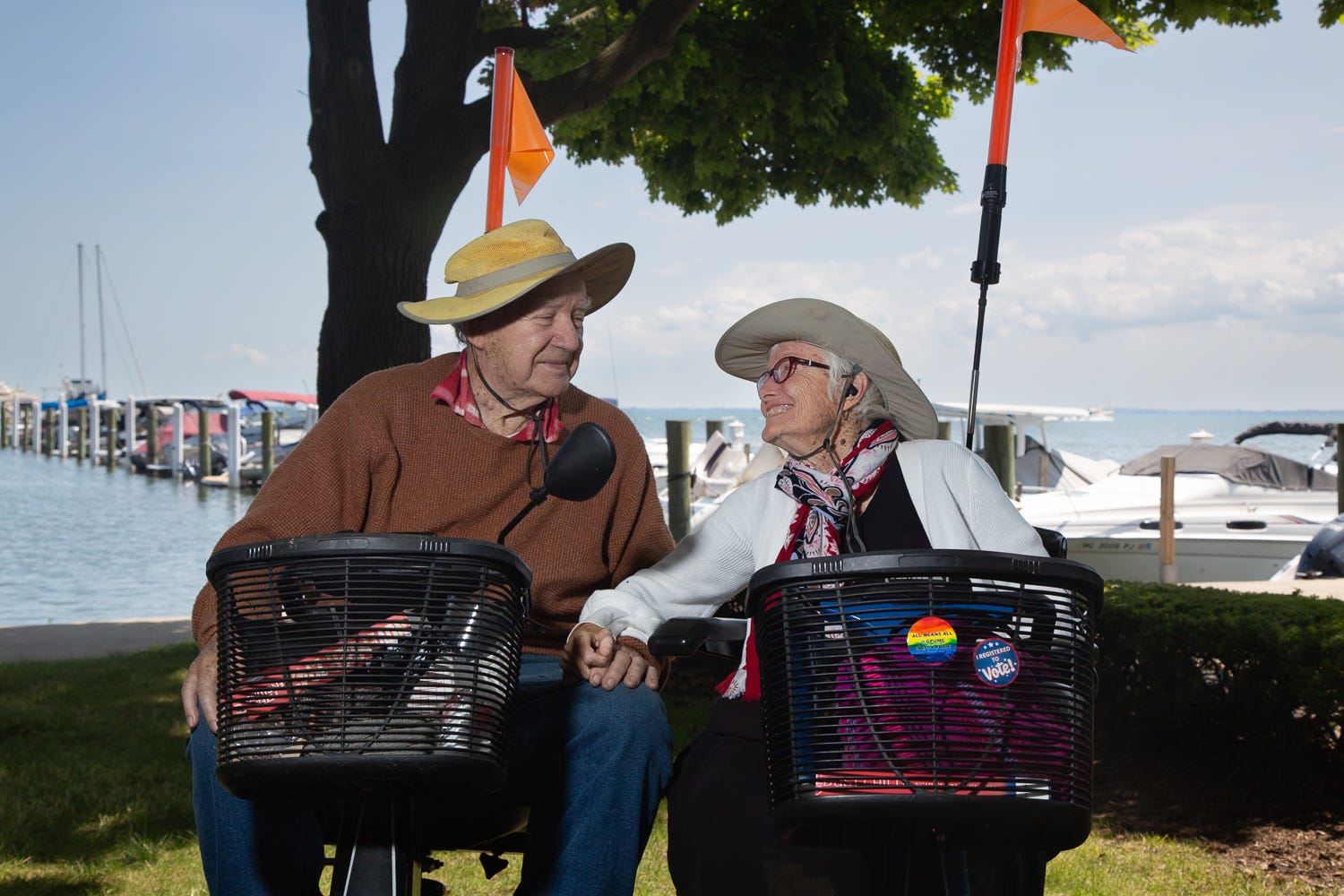
Patricia: I started it in 2000, when I was living part of the year in San Francisco. I would live on my own, my husband Eddie stayed here. I just started keeping an online journal. That was before there was even the word, ‘blog.’ I had a website, and I was obsessive about it. I’d write on it every day from 2000 to 2006. Then, I got a little point-and-shoot camera to add pictures to it. That was when I got interested in photography, and decided I got tired of words, and I just wanted to do camera.
Laura: Were you a writer before you were a photographer?
Patricia: You know, I’ve always written, one way or another, always.
Laura: When you went to art school, was it for photography?
Patricia: No, not at all. No, I had never done anything with cameras, it was visual art. I was a watercolor painter. I’d been winning awards for my work, but I couldn’t draw, so I decided to go to the Center for Creative Studies here in Detroit. I went through a year and a half, just taking a lot of life drawing, life sculpture, basic art and design, you know, just to learn how to draw, because that’s a skill. Then I got real involved in the art world. Whenever I do anything, I jump in. I can’t help it. I was part of cooperative galleries, exhibits and stuff like that. So, that’s what I brought to photography was that background.
The Scooter
Laura: When did you start mobilizing with the scooter?
Patricia: The scooter I got in March of 2000. That was in connection with my peace activism. I was using a walker that I decorated and put wind chimes on. She was called “Wind Chime Walker.” I had a website called Wind Chime Walker. It’s still up. Anyway, I couldn’t do all the demonstrations I wanted to do with my walker; I couldn’t go far enough. There was going to be a mammoth international summit about immigration issues. In Seattle, in 1999, there had been a huge demonstration that became very famous. The police tried to stop it, and the organizers wouldn’t let it be stopped. It was really quite phenomenal. We were having that over in Windsor, and I knew I needed to be there for 5 days. There were going to be lots of teach-ins and everything, but I needed to be able to move around. So, that was when I got my scooter.
Laura: It seems like your life is leading your disability more than your disability leading your life. It can be easy to get wrapped up in disability being your only identity.
Patricia: I must admit, the first time I became aware of my identity as a disabled woman was when I started doing the self-portraits. I thought it was going to be physically hard to take the picture, but it wasn’t, really. I just came up with all kinds of techniques. It wasn’t hard, but the hard part was looking at the pictures on my computer afterwards, because I was seeing myself as other people saw me, and all of a sudden, I saw how disabled I looked. That was hard. It was like I went face-to-face with it all.
So, that really helped me in a lot of ways, because I then could claim my disability. What I began to realize was that my body was a warrior, because I was not letting this stop me. That was what I saw. It was really an important thing.
Caregiver Appreciation
Patricia: I’m geographically limited and not able to travel anymore, because I need a caregiver in the morning and a caregiver in the evening, every day, seven days a week. So, you know, that’s my life now, and a lot of life is just trying to find replacement caregivers when someone leaves. My focus has changed, my goals have changed. I used to have a lot of professional goals as a photographer, as an artist. Now, my main goal is for Eddie and me to be able to stay in our home. That is my main goal, whatever it takes for us to stay in our home. So, really, my focus now with my photographs, because my photographs are always what’s happening in my life, I have a lot of photographs of my caregivers. I love showing people, these wonderful people, who are so much more than you think. I want them to be valued, and I want people to see their individuality. I love showing off Sharnita, and just every one of them, each in their own way, are making our life possible.
And then there’s Brenda, Magic Brenda, I don’t know what we’d do without Magic Brenda. She comes Monday through Thursday evenings. God, she can do anything. So, you know, just whatever’s going on in my life, that’s what I photograph, and that’s what my projects are. Also, Eddie’s World, you know, Eddie is my main person. He’s the person I’m with all the time, so I’ll just take pictures of Eddie, doing everything. He keeps coming back.
What do you like to do for fun?
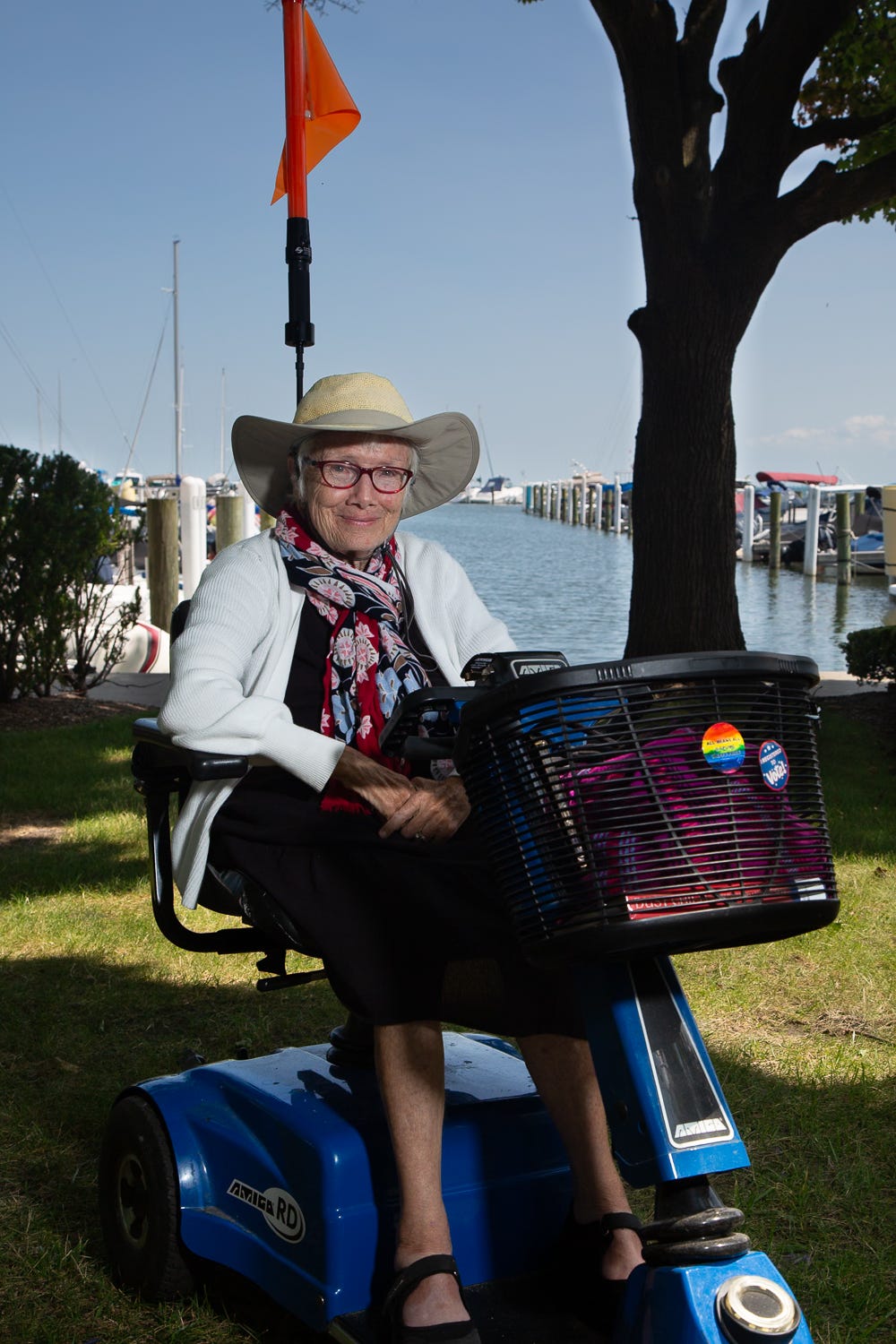
Patricia: Well, Eddie and I love to come down to the park. Eddie loves getting his special hot dog and fries from the concession stand. And for me, really, my most important thing, and it’s why winter’s really hard for me here, is I need to be able to get out and scoot. I need to be able to get out of the house. That’s my freedom. I go as fast as I can go, and I don’t have to be going anyplace, I just really need to get out. And that, to me, is again, something that if I were in a facility, they would not let me do. That would be a nightmare.
I love to read. I read novels that give me a different point of view, a different perspective. The one I got this morning is written by a Vietnamese writer and novelist. She was raised in Vietnam, and, you know, I love being placed someplace else. In someone else’s head. I like to learn from them.
What motivates or inspires you?
Patricia: Just getting up in the morning and still being at home, and having Eddie still at home. Being aware of how grateful I am, because I can look back. I’m old enough to look back and see the things that now I’ve lost, that at the time, I didn’t realize they were that precious. But now I’m trying to be very aware of every gift that I have, and being grateful, and being aware of it, and being present in the moment.
What change would you like to see for disabled people in the future?
Patricia: To me, it’s all about accessibility. Just let us be able to go and do what we want to go and do. I feel very fortunate. We live in a community where, really, everything is accessible here. We moved into our house 53 years ago. I was running marathons at that time, so I would never have known that accessibility would be important, but it’s a very disabled-friendly community to live in. It’s marvelous. So, I would like that to be true for everybody, and whatever one needs, especially, like, caregiving, I want that to be paid for. I don’t want it to be that you have to get rid of everything to get on Medicaid to have it paid. We need to be able to have the care that we need, and have it taken care of.